
Farewell Gregg Popovich
A round up of all the must reads on the NBA legend they call "Pop"

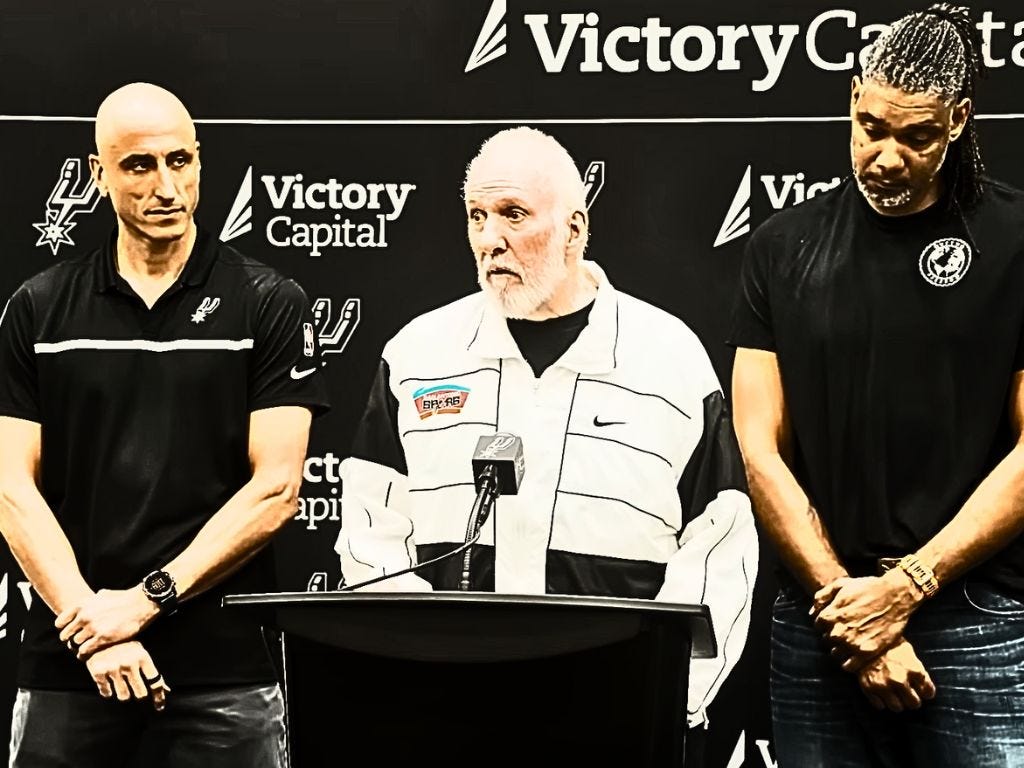
Earlier this month Gregg Popovich stepped down as the head coach of the San Antonio Spurs to become its president. It ended an almost three decade run for the 76 year-old. The day he told the basketball world the news he was stepping down as coach, he was escorted to the podium by the entire Spurs team. That was really cool.
He leaves the game as coach very much on top as someone revered and adored. The numbers and countless accolades he racked up over his career are incredible. His win-loss record will stand at 1,422-869. He won 170 playoff games with the Spurs which is the most with one team and third most overall (Phil Jackson 229, Pat Riley 171). He took the Spurs to 22 consecutive playoff campaigns.
Pop, who started his head coaching career at 48, became a x5-time NBA Champion, along with three NBA Coach of The Year awards. When the NBA turned 75, Pop was named in the Top 15 Greatest Coaches in NBA History. He won gold at Tokyo Olympics and coached six Hall of Fame players in Ginobili, David Robinson, Tim Duncan, Tony Parker, Dominique Wilkins and Pau Gasol.
This Reddit thread talked about the sadness of not having Pop in the NBA spotlight anymore. “He was only two play off wins away from having the second most playoff wins in history,” said ArchieFresh. “Definitely sad. But I'm hoping to see him as a coach's coach, where he imparts his wisdom, knowledge and experience on Mitch and the assistants,” wrote Philthemage. “Glad it's not a full retirement but taking a step back is the right call,” said NittanyScout.
Here’s a collection of reads on Pop that I thought will give everyone a greater appreciation of what he meant to the game of basketball and the people who were fortunate enough to work for him.
One thing is for sure. He was the best ever.
The Atlantic “Gregg Popovich Life Lessons”
Pop did things differently. This piece by Adam Harris explores counterculture and how Pop created his own universe within the NBA.
“He’s not afraid to be countercultural,” Robinson said. Mainstream basketball culture was self-congratulatory, but Pop’s style, Robinson suggested, was to say, “No, don’t look at me.”
The Ringer “Gregg Popovich Has Always Been More Than A Coach”
Danny Chau tackled the secrets to Pop’s success as a coach, but also as a human, mentor, friend, and listener and how he’s made an art out of reading people.
“Do what you do, do it well, and do it with passion. But do not worry about plaudits or condemnation, because both are going to come your way,” Popovich has said. “Whether you’re the manager of the local McDonald’s, the coach at Pomona or Phil Jackson with the Chicago Bulls, you are going to get plaudits and you are going to get condemnation and they’re both false notions. You need to care about how you do your work and how you treat your family and friends. Nothing else matters.”
Slam “Gregg Popovich Leaves Behind A Legacy of Greatness in San Antonio Hoops”
The part for me that stood out in this Luke Kaiser piece was just how little time it took Pop to transform the Spurs into a threat. It took him three years to win a Championship on the back of simple defensive structures, slow tempo, high movement and grinding opposition ball clubs.
The Ringer “For Some Coaches the NBA Isn’t A Passion — It’s An Addiction.”
Howard Beck dug into the addictive nature of coaching at the highest level explaining why it’s hard to walk away from the game. Not only do other coaches talk about coaching being addictive, but it also becomes your identity. And when you’re no longer doing the thing you’ve been doing for 20 years you can become lost. And there’s a struggle to find yourself again.
“When you’re in it, you’re addicted to the juice of the game,” George Karl says. “When I became a coach, I got the juice of coaching and having success and trying to be the best at it. And I was addicted. I was addicted to trying to be a hell of a coach. And in the end, as you look back on it, it’s probably not healthy.”
Pounding The Rock “An Appreciation of Gregg Popovich.”
This was good from Marilyn Dubinski. A real, first-person and personal tribute to Pop.
“That being said, I didn’t know much about Pop at the time. The internet was still very young, and search engines were just becoming a thing. All I knew was my grandmother, who was a passionate Spurs fan, hated Pop, thought he was jerk and snake in the grass, and didn’t think he could lead the team to the promised land.”
Texas Monthly “Last Thoughts On Gregg Popovich.”
Loved this from Dan Solomon. He touched on the Pop v media relationship and how he handled the press. We got to see Pop in his element, wrestling with journalists as they listened to his sermons about leadership, team work, and growth when all they wanted was a breakdown on the meaning of the result.
“Pop’s curt demeanor with the press helped, too. He was never arrogant, never the sort of Belichickian jerk whose contempt for the media translated into contempt for fans,” wrote Solomon. “Rather, he seemed to relish the chance to spar, and he was disappointed when press conferences failed to present the opportunity.”
The Athletic “I Played For Gregg Popovich.”
Shawnelle Scott only played for Pop for one season. But what he learned in that time impacted him. Scott wrote a brief look at that with plenty of bite-sized takeaways.
“This guy was the same with everyone.I learned the most from just watching him, day after day. That year, we were playing Chicago. They were terrible. But we lost. Everyone had their heads down. I knew we had practice the next day, and I was thinking in my head, “Oh my God. Practice is going to be ridiculous.” I thought Pop was going to chew everybody out. But it was the exact opposite. Practice was non-contact. We just went over all our offensive sets, every last one of them. Just the basics of everything.”
The Athletic “What Can We Learn From Gregg Popovich About Leadership.”
Rustin Dodd broke down Pop’s career and leadership in a lessons format explaining how things like trust, holding people accountable, details and being different were things Pop truly valued and others bought into it.
USA Today “Six Ways Gregg Popovich Impacted The Spurs.”
Out of the six things that Jeff Zillgitt wrote about, the one that Pop definitely deserves credit for was how he mastered the ability to find the right international talent. It’s been heavily documented that Pop picked players that fit his system versus trying to find superstars then figuring out how they fit into a team.
“Popovich didn’t introduce international players to the NBA, but his worldview and open-mindedness understood how basketball was played in Europe and how it could impact the NBA. Parker, Ginobili, Boris Diaw and Mills were instrumental in San Antonio’s success.”
The Guardian “The Truth Teller.”
This was a strong opinion piece from Andrew Lawrence who illustrated Pop’s backbone perfectly on and off the court. Especially when it came to having a voice about the president which most NBA coaches avoid.
“Certainly no one was bolder when it came to taking on Donald Trump – whom Popovich has described as a “soulless coward,” a “pathological liar” and a “deranged idiot”. Popovich told beat reporters he was “sick to my stomach” after Trump’s 2016 presidential election win, a tipping point he likened to the fall of Rome.”
ESPN “The Secret Team Dinners That Built a Dynasty.” (2019)
This is an older piece by Baxter Holmes but it’s one of the best reads on Pop and how he went about forging relationships and building trust with his players and staff.
“Popovich is already on his way, making a mad dash in a private car to the waterfront eatery. Tables are rearranged -- the team will sit in the center, coaches nearby, a ring of family around them. Popovich orders food. He orders the wine. He sits at the head of a table, takes a sip of wine and gathers himself. As the team bus arrives, he greets every Spur who passes through the door.
Over the next few hours, Popovich works the dining room -- talking to players, rubbing their shoulders. "In terms of just trying to just hook everybody up to life support and resuscitate everybody, it was the most amazing display of leadership," former Spurs assistant coach Chad Forcier says. And though the Spurs didn't win that series, losing to the Heat in Game 7, they would destroy Miami the following June, in five games.”