
An Ode To Being Clutch
The most alpha move in basketball and what it takes to be clutch.

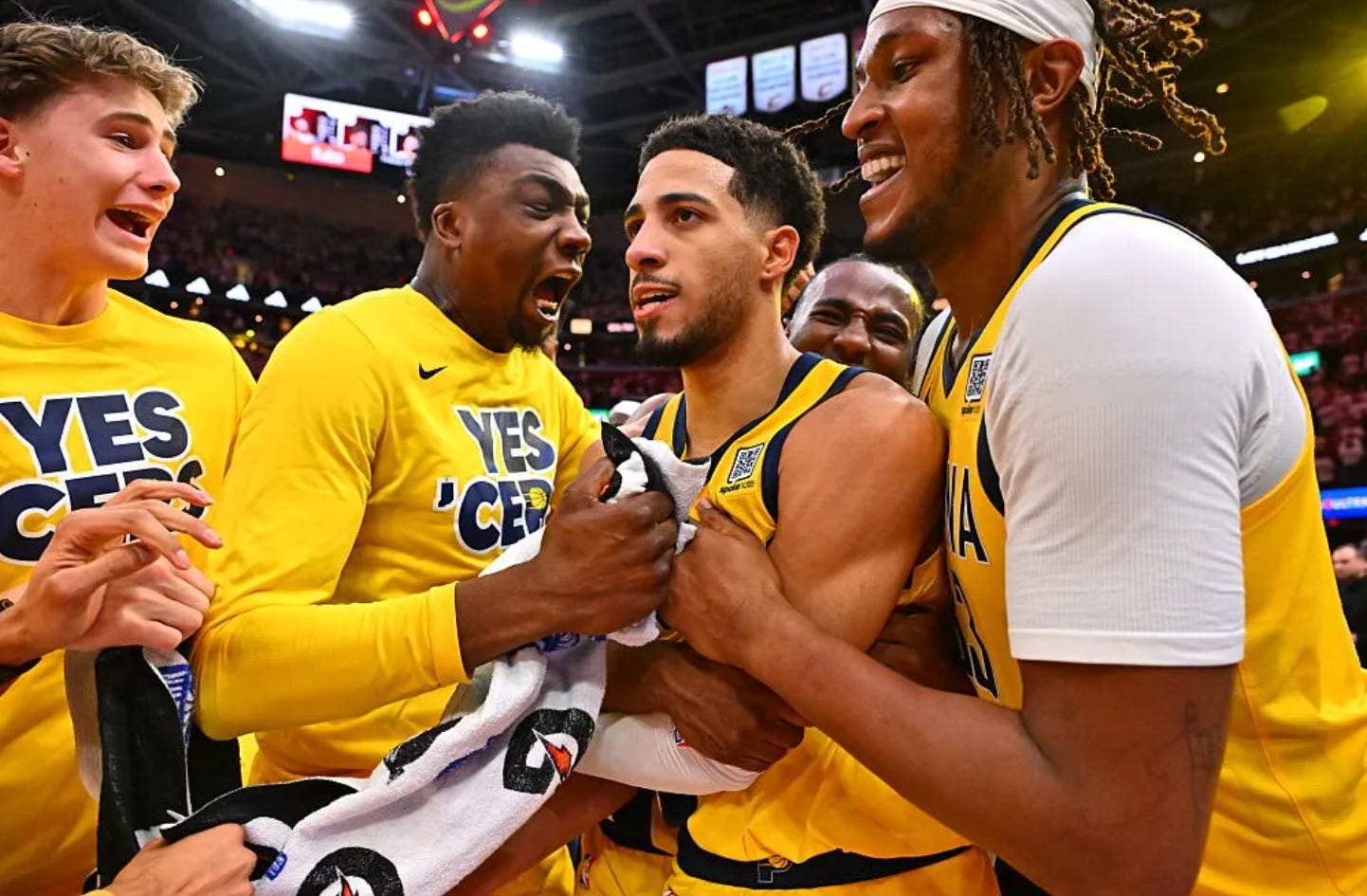
Tyrese Haliburton has become electric in these playoffs. His rhythm, pace, ball-handling and shot have given the Pacers everything they need to win tight, grinding games. And simply: some of the things he’s been doing on court have been ridiculous. Remember the fadeaway three-pointer against the Bucks that tied the score at the end of regulation?
Then in Game 1 of the NBA Finals, Haliburton hit a cold-blooded shot to win it for the Pacers. As much as coaches and teams try to plan and choreograph these final-second Hail Mary plays, watching the replay you can see how sometimes, in the chaos, processes can break down. But then there are those who stay composed.
Haliburton had the ball in his hands at half court as the clock ticked down from 6.2 seconds. Oklahoma was up 110–109. Haliburton was bobbing and weaving across the court, feverishly searching for space. Wallace was on him like glue and Haliburton's teammates were locked up.
But Haliburton did what good players do. He found just enough space through a series of shimmies, a couple of stops and starts to lose Wallace for a split second. That was enough time for Haliburton to get inside the three-point arc and drop a contested long two that went in with 0.3 seconds left. The Pacers won 111–110 in Oklahoma.
When I was growing up watching the NBA in the '90s, I was completely mesmerized by the clutch shot. Michael Jordan’s buzzer-beater in Game 5 against the Cavs in ‘89 gave me chills. He hit the iconic mid-range jumper on the buzzer in Cleveland, a shot that defined him as the next great clutch man. It was one of the most replayed shots I remember from that time. It took basketball into a new era.
The Bulls had a lot of highlight reels throughout the '90s. Guys like Pippen and Kukoc had clutch moments. Rodman produced clutch plays on the defensive end. Paxson. Kerr. But Jordan wanted to be clutch and didn’t shy away from the fear or the potential failure. He wanted to be the alpha, the last man standing with the ball in his hands and four seconds on the clock.
Jordan’s list of clutch moments reads like a long grocery list. When the Bulls played the Lakers in 1991 in Game 3, the Lakers went on an 18–2 run in the third to lead by 13. The Bulls rallied with a 16–7 run to close out the quarter, pushed the game to OT and won by eight. No buzzer-beater this time, but Jordan finished with a game-high 29 and was perfect from the foul line (6-for-6); he hit late free throws to ice the game.
What about the “shrug” game? Game 1 against the Trail Blazers in the 1992 NBA Finals. Jordan went on a tear with 35 first-half points, including six triples (6-for-10). The Bulls won by 33. Coaches talk about setting the tone early. Jordan completely unravelled Portland in a massive first-half statement during the pinnacle event—the Finals. It set the tone for the rest of the series.
Some of his epic scoring feats appeared in big clutch games. He dropped 55 on Phoenix in Game 4 of the 1993 Finals, giving Chicago a 3–1 series lead. In Game 1 against the Jazz in 1997, Jordan hit a game-winning jumper from 19 feet with 7.5 seconds left to win 84–82. Then in Game 5 of the same series, he scored 38 with the flu, including a late triple with 30 seconds to go that gave the Bulls the lead.
Some of this is just Jordan being Jordan. It’s not like he had to elevate his play in the final two minutes—he played with intensity from tip-off. Whether it was working the opposition over to shoot a baseline fadeaway or a signature turnaround, his late-game heroics didn’t deliver anything we hadn’t already seen.
What Jordan did have was an array of skills that helped him in the dying moments. He was a master of tempo when the game was on the line, whether protecting a lead or taking the game on. He trusted teammates—Pippen, Paxson, Kerr. The biggest thing of all: Jordan was never afraid to live in the moment, win or lose.
Jerry West knew what it meant to be clutch. His long-range bucket in Game 3 of the 1970 NBA Finals between the Lakers and the Knicks has long been regarded as the play that triggered the clutch mindset. He became more than a one-shot wonder. His precise shooting late in games became his legacy.
In that Game 3, with three seconds left, the Lakers were down two. No timeouts. They had to run the full length of the court and score to push the game into overtime.
Wilt Chamberlain threw the ball to West. He took a dribble and a few steps, pulled up from around half court, and banked a 60-foot shot to tie the game. There was no three-point line in 1970—otherwise, that would have won the game. But that shot created a buzz. It was dramatic. At the time, the long bomb felt more like a trick shot. It was uncommon.
That bucket evolved West. He became known for his precision shooting in tight games, so much so, he earned the nickname “Mr. Clutch.” Now, the NBA has an award named after him for the league’s best clutch player.
Jalen Brunson was a brick wall for the Knicks this year. In the 2024–25 season, Brunson was awarded the Jerry West Trophy for Clutch Player of the Year—given to the player who consistently delivers for his team late in close games. Brunson led the league in field goals made (52) in the final five minutes of the fourth quarter or overtime when the score was within five points. He ranked second in total points (156), shooting 51.5% from the field and 84.0% from the free-throw line in clutch time. In the 28 clutch games he played, the Knicks had a 17–11 record.
Brunson is the perfect fit for the Knicks, running and controlling the ball at point. That alone carries a lot of pressure. Protecting the ball with one or two defenders swarming you, especially when the clock is ticking and you’re behind, is a deft skill. Then, you have to make the right pass, play, or shot.
What stood out about Brunson’s clutch game was his foundational traits: patience and gritty resolve—essential attributes for any clutch performer. Throughout the year and into the playoffs, Brunson never backed down from high-pressure moments. Some players melt. He didn’t. Even with his unconventional style, he was effective.
Brunson likes to prod his way through traffic. He twists, draws defenders into awkward spaces, takes contact, draws fouls—and still scores. What makes him clutch is his ability to hit precision shots under duress: pull-up jumpers, drives to the rim, spin moves from the baseline. And then he does things like drop clutch threes—like the one against Detroit with 4.2 seconds left to clinch the series 4–2.
In Game 7 of the 2014 series between the Raptors and Nets, Joe Johnson imposed himself on Toronto, scoring a game-high 26. Most impressive: he dropped 13 in the final quarter with the game on the line. The Raptors rallied from a 10-point deficit to within three, but Johnson came up big in the closing moments. He didn’t hit a buzzer-beater, but his composure made him the most important player on the floor. He was clutch in how he isolated defenders, hit mid-range shots, posted up, and nailed contested floaters. He collapsed Toronto’s zone and created better looks for his teammates. Everything he did was clutch.
The idea of being clutch has shifted. It’s no longer just the final shot with three seconds left. Clutch has seeped into all parts of the game. It’s less about vibe, more about preparation, repetition, and analytics.
A 2021 study, "Exploring the ‘Clutch’ in Clutch Performance," examined how athletes perceive and experience clutch moments. Athletes said clutch is defined by how they internally process pressure, which they felt is subjective. They also said clutch moments can be multiple short peaks within a play or game and that clutch performers don’t always feel calm and much of their success depends on how they manage pressure.
Here were some other takeaways:
Clutch is not universal. Two players in the same situation may assess pressure differently.
Clutch players regulate their internal state, not just hit shots.
Clutch is a multi-dimensional skill: situational awareness, emotional control, tactical execution.
Writer Josh Sipkin also challenged the idea that clutch is rare. He believes clutch performance stems from solid habits holding up under pressure. High-rep, high-pressure practice and clear decision-making routines help form the clutch mentality.
Another 2021 study, "The ‘Clutch Gene’ Myth" (UC Berkeley), explored how clutch is about routines and context—not just hero-ball moments. The study examined NBA clutch shooting over 11 seasons (2008–2019) and defined clutch as the final five minutes of games within six points. It found no player consistently shot better than their average. Field goal and free throw percentages declined in clutch scenarios. While occasional peak performances occurred, some players choked more often under pressure.
In the modern NBA, players over-possess the ball to exploit defensive gaps. Parity is high. Teams know who shoots 42.3% from deep in the final three minutes. Clutch was never thought of like that, but now the game is won or lost in the spreadsheets.
Clutch looks different. It’s expanded to include passing, rebounding, defensive switches, and poise in chaos. A hard closeout without fouling is clutch. Swinging to the open man is clutch. Hitting the assist instead of forcing a shot is clutch. Crashing the glass for a stop is clutch. Pulling up with three seconds left is still clutch, but more players are involved when the game is on the line. Every team values different moments. What’s clutch to the Warriors might differ from the Heat. In a world of efficiency and value, it's harder to judge a final play based solely on instinct.
Here’s a sentence I didn’t think I’d write: Let’s not forget Aaron Gordon’s heroics in these playoffs. In Game 1 against the Thunder, the Nuggets were down one. Gordon sprinted to the left wing, made space, and hit a three with 4.2 seconds left to ice the game 121–119. It looked like a routine long-range shot. But it’s the NBA playoffs. Everything is layered. And harder. Then, in Game 4 against the Clippers, Gordon caught an airballed three from Jokic and dunked it at the buzzer to tie the series 2–2. Two significant clutch plays in back-to-back playoff series. Gordon is just the latest example showing how clutch can come from anywhere.
I say all of this to point out how incredible the clutch moments have been in these 2025 playoffs. Throughout the season, teams and players have taken the game on. Coaches talk about having a "clean slate" when mistakes happen. "Be a goldfish," they say—to let go of the past and stay in the moment.
As a basketball fan, I used to think of being clutch as a rare, unattainable skill. And maybe it still is. But watching these players, they all seem to have one thing in common: tranquility. They run, catch, and shoot with a free mind. They know the pressure is on, but the best ones live in the moment—free from the past 47 minutes, free from the fear of missing. The great ones embrace the fear. The great ones are willing to fail.
As you watch the rest of these playoffs and wait to crown the next NBA champion, think about Jerry West, Michael Jordan, Joe Johnson, Aaron Gordon, Jalen Brunson, Tyrese Haliburton—and the players who made the world hold its breath. The ones who defined clutch by being unforgettable.